Sky-Collapse Analysis
Identifies finite, locally distorted, and pseudo-textured sky depth as a recurring failure mode in diffusion-based monocular depth models.
aSchool of Computer Science and Engineering, Shenyang Jianzhu University
bSchool of Chinese Medicine, Beijing University of Chinese Medicine
cShenyang Branch of the National Special Computer Engineering Technology Research Center
dInfiniFlow (Shanghai) Information Technology Co., Ltd.
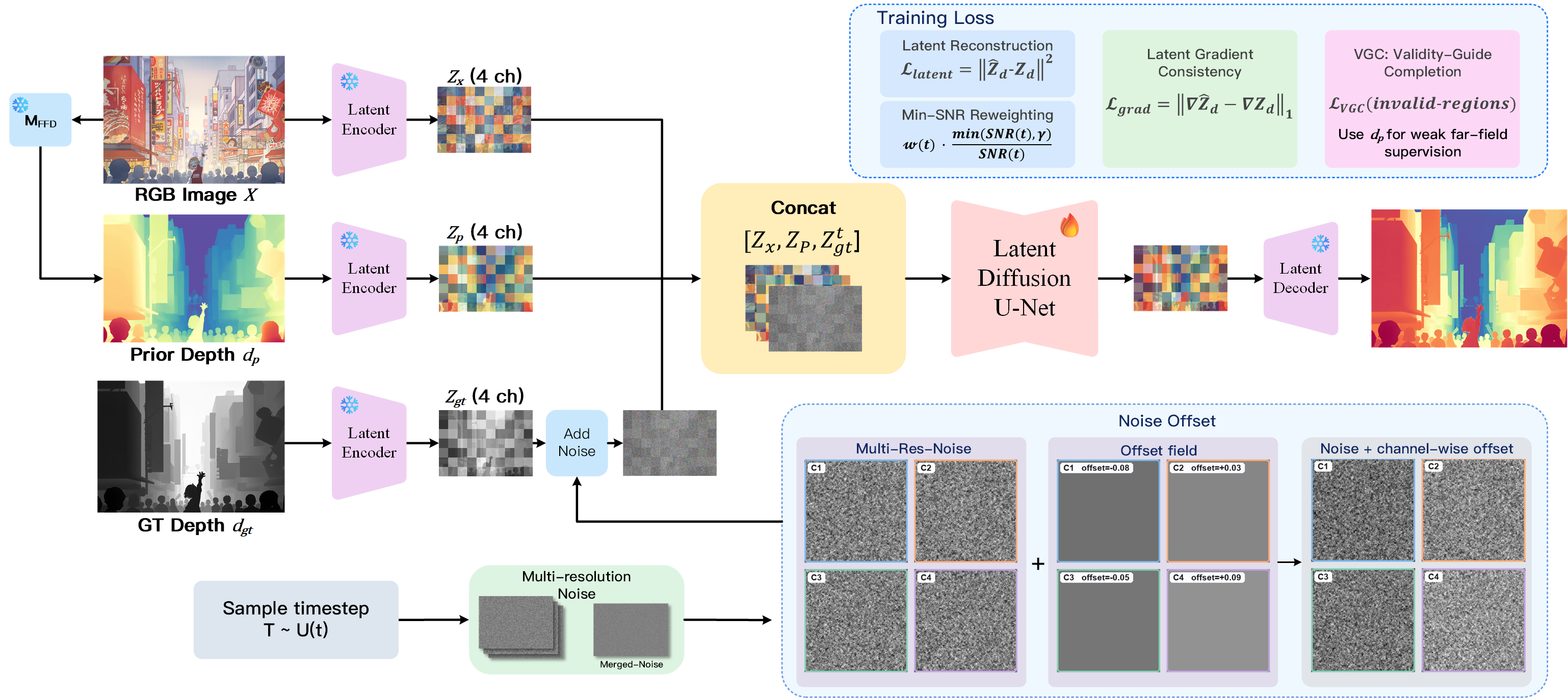
Abstract—Diffusion-based monocular depth estimation can recover detailed scene geometry, yet their outdoor predictions may assign nearby depths or artificial depth variations to the sky. We study this sky-depth collapse as a supervision problem: depth validity masks remove unreliable measurements, but can also leave large sky and out-of-range regions without a direct training signal. We present Celeste, a multi-step latent diffusion framework that addresses this gap through validity-guided completion. The method separates fully valid, fully invalid, and mixed latent cells, applies weak region-level anchoring and interior smoothness on invalid support, and adds a selective far-field anchor to reduce the ambiguity of distant regions. We use a frozen depth estimation model as an auxiliary condition and a weak reference. To make the denoising trajectory consistent with its pure-noise initialization, we align the high-noise training endpoint with inference and attenuate structured noise near that endpoint. The resulting formulation is designed to improve sky stability while preserving supervised foreground structure, without requiring sky annotations during training.
Index Terms—Diffusion model, monocular depth estimation, sky collapse, depth refinement, geometric diffusion.
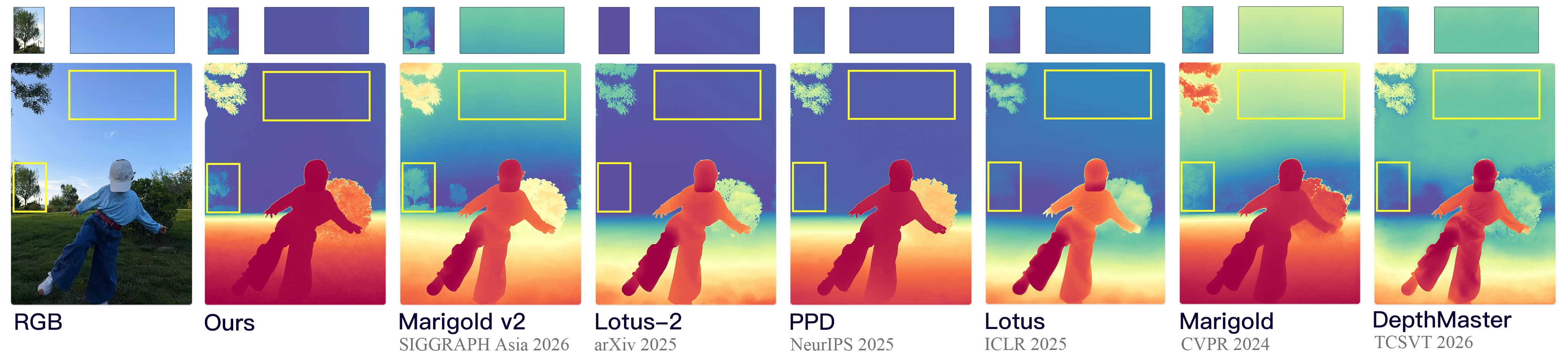
Identifies finite, locally distorted, and pseudo-textured sky depth as a recurring failure mode in diffusion-based monocular depth models.
Restores a multi-step, depth-prior-guided reverse trajectory that progressively corrects uncertain latent geometry in sky and long-range regions.
Combines offset-noise regularization, SNR-based loss reweighting, latent gradient consistency, and sky-aware refinement.
| Type | Method | Training Data | NYUv2 | KITTI | ETH3D | ScanNet | DIODE | |||||
|---|---|---|---|---|---|---|---|---|---|---|---|---|
| AbsRel↓ | δ1↑ | AbsRel↓ | δ1↑ | AbsRel↓ | δ1↑ | AbsRel↓ | δ1↑ | AbsRel↓ | δ1↑ | |||
| Discriminative | DiverseDepth | 320K | 11.7 | 87.5 | 19.0 | 70.4 | 22.8 | 69.4 | 10.9 | 88.2 | – | – |
| MiDaS | 2M | 11.1 | 88.5 | 23.6 | 63.0 | 18.4 | 75.2 | 12.1 | 84.6 | – | – | |
| LeReS | 354K | 9.0 | 91.6 | 14.9 | 78.4 | 17.1 | 77.7 | 9.1 | 91.7 | – | – | |
| Omnidata | 12.2M | 7.4 | 94.5 | 14.9 | 83.5 | 16.6 | 77.8 | 7.5 | 93.6 | – | – | |
| HDN | 300K | 6.9 | 94.8 | 11.5 | 86.7 | 12.1 | 83.3 | 8.0 | 93.9 | – | – | |
| DPT | 1.4M | 9.8 | 90.3 | 10.0 | 90.1 | 7.8 | 94.6 | 8.2 | 93.4 | – | – | |
| Depth Anything V2 | 63.5M | 4.3 | 98.0 | 8.0 | 94.6 | 6.2 | 98.0 | 4.3 | 98.1 | 6.6 | 95.2 | |
| Generative | Marigold | 74K | 5.5 | 96.4 | 9.9 | 91.6 | 6.5 | 96.0 | 6.4 | 95.1 | 10.0 | 90.7 |
| GeoWizard | 280K | 5.2 | 96.6 | 9.7 | 92.1 | 6.4 | 96.1 | 6.1 | 95.3 | 12.0 | 89.8 | |
| DepthFM | 74K | 6.0 | 95.5 | 9.1 | 90.2 | 6.5 | 95.4 | 6.6 | 94.9 | – | – | |
| GenPercept | 90K | 5.6 | 96.0 | 9.9 | 90.4 | 6.2 | 95.8 | 5.6 | 96.5 | – | – | |
| Lotus | 54K | 5.3 | 96.7 | 8.5 | 92.8 | 5.9 | 97.0 | 5.9 | 95.7 | 9.8 | 92.4 | |
| DepthMaster | 74K | 5.0 | 97.2 | 8.2 | 93.7 | 5.3 | 97.4 | 5.5 | 96.7 | – | – | |
| ApDepth (Ours) | 74K | 4.5 | 97.3 | 8.7 | 93.7 | 5.6 | 96.3 | 4.5 | 97.3 | 8.3 | 93.2 | |
| Celeste (Ours) | 74K | 4.5 | 97.2 | 8.0 | 94.4 | 5.1 | 96.9 | 4.5 | 97.3 | 7.8 | 94.2 | |